
Ten Favorites
New to the site? Start here. These ten photographs give a quick tour of the rock art styles on this site. Each one links to its full gallery.

This painting is the centerpiece of the Great Gallery and is referred to sometimes as the Holy Ghost and Attendants. The dominant figure is surrounded by forms of different size, providing depth. Its torso was created by pecking fine lines and blowing or splattering paint onto the rock, creating the appearance of a buffalo robe. The attendant figures were pecked after they were painted, possibly by others.
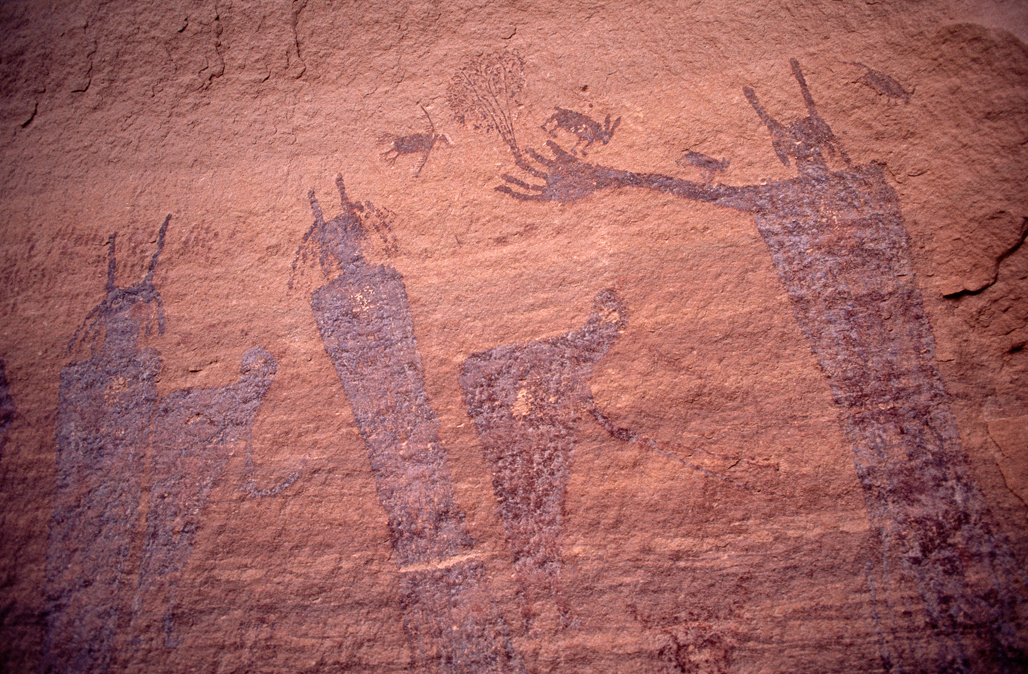
A section of the famous Harvest Scene panel in The Maze, Canyonlands, Utah. Two figures are harvesting and may be carrying baskets on their backs. The form on the right is presumed to be holding an Indian rice grass plant.

The Rochester Panel, of which this is a small section, exhibits a remarkable variety of imaginative creatures. Some images may be Fremont, and so later than Archaic.

The striking headdresses on these anthropomorphs are a feature of the Western San Juan Basketmaker style. Notable too are the earrings, chest decorations, and sashes. The figure on the left shows an animal within the torso, similar to some of the Barrier Canyon Style figures at the Great Gallery. A theory is that the hanging feet represent a trance state. The figure on the right may be wearing a mask.
See the gallery: Western San Juan Basketmaker-style Petroglyphs
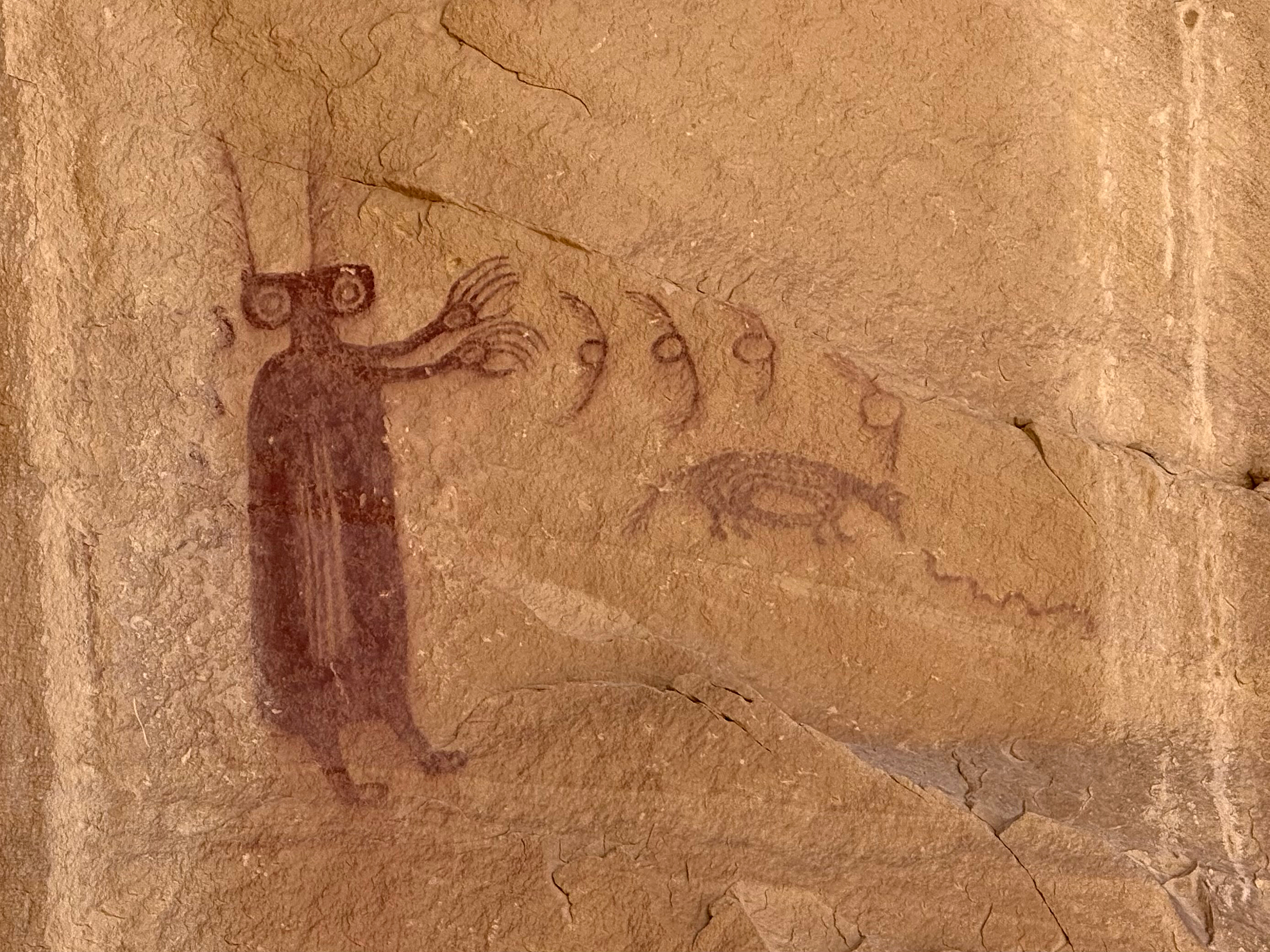
This human-like form is notable for the length of the fingers and the holes in the hands and feet as well as the "feathers" on the head. The four forms above the zoomorph and snake could be birds.

The well-known Five Faces panel. This panel is situated partway up the wall of a small alcove. One generally views it from the other side of the alcove, about ten meters away, unless one wants to walk a narrow ledge. It is best seen in morning or late evening when the sun is not on it. High above this panel is a separate panel with handprints.

These nearly life-sized male figures are situated on a cliff wall looking down into the canyon below. Noteworthy are the large size and coloration, the earrings and necklaces, and the depiction of the hands and feet.
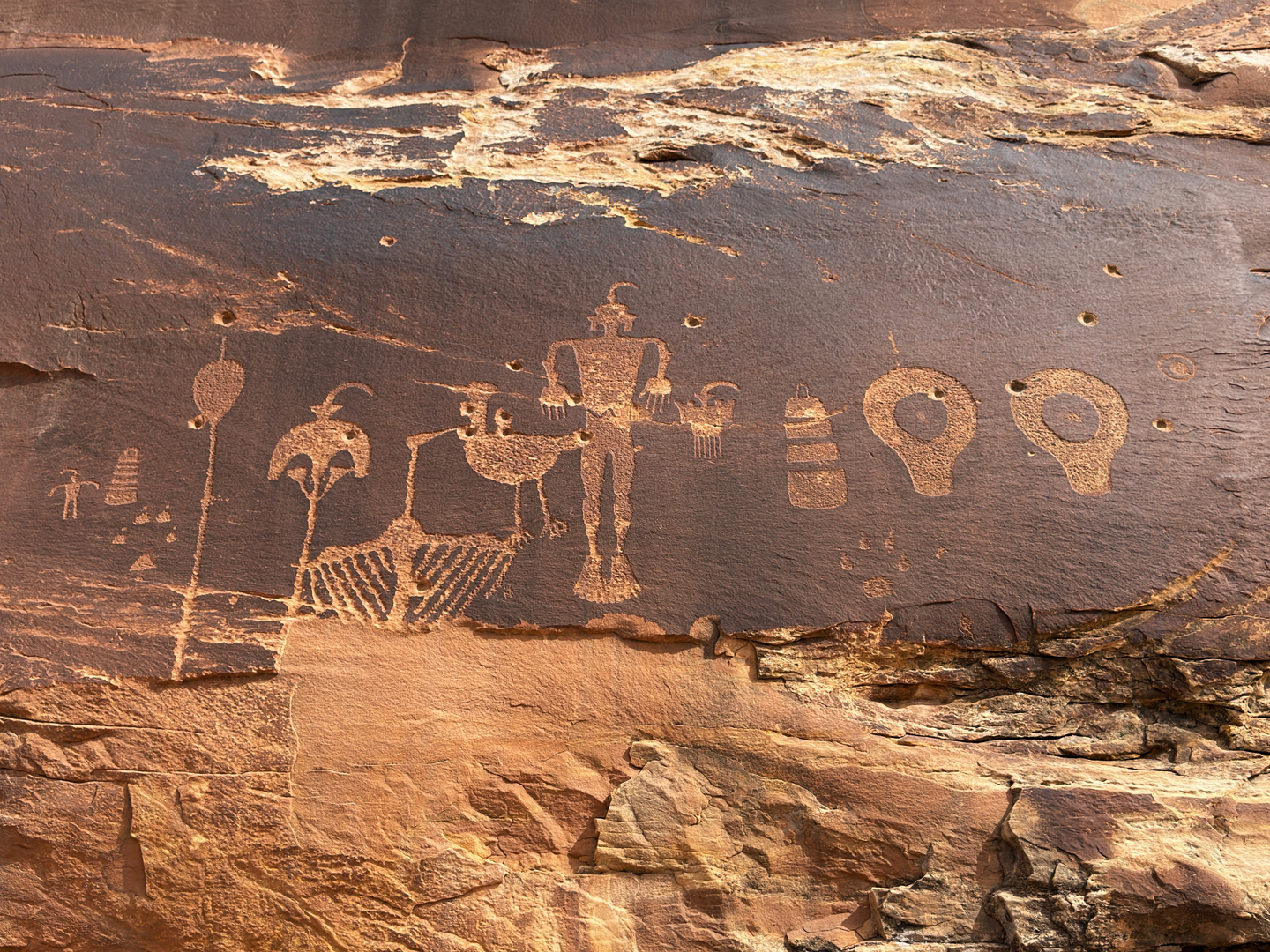
Forms on this panel may be baskets, an atlatl dart, a staff, birds, animal prints, and the well-defined anthropomorph. The “light bulb” forms on the right are seen on many Ancestral Puebloan panels in the area, and no one has any idea what they represent.

Hunters using atlatls and darts attack sheep in what may be a field of corn. A flute player floats beside.

On July 4, A.D. 1054, inhabitants of earth saw a bright object in the sky, easily visible in daytime - the supernova that created the Crab Nebula. The moon was a small crescent. Some think the Ancestral Puebloan people in Chaco Canyon recorded the supernova event with this rock art panel.
In the spring of 1066, twelve years after the supernova, Halley's comet appeared. That event may be depicted lower on the panel with the circles and very faded paint trailing off to one side, like a comet’s tail.