
The Great Gallery in Horseshoe Canyon
Many consider the Great Gallery in Utah’s Horseshoe Canyon to be one of the finest rock art panels in North America. More than 60 painted and pecked figures line 200 feet (about 60 meters) of its cliff wall. Many of the human-like forms are life-size. This place was once called Barrier Canyon, and when archaeologist Polly Schaafsma defined the Barrier Canyon Style in her 1971 book The Rock Art of Utah she named it for these paintings. Early estimates dated the images as far back as 8,000 years ago although newer studies suggest they are only 1,000 to 2,000 years old.

This painting is the centerpiece of the Great Gallery and is sometimes called the Holy Ghost and Attendants. The commanding central figure is surrounded by forms of different sizes, which give the scene a sense of depth. Its torso was made by pecking fine lines into the rock and then blowing or spattering paint over them, giving it the look of a buffalo robe. The attendant figures were pecked after they were painted, possibly by later cultures.

The Great Gallery panel. There are more paintings to the left (see below) and there are other rock art panels in Horseshoe Canyon.
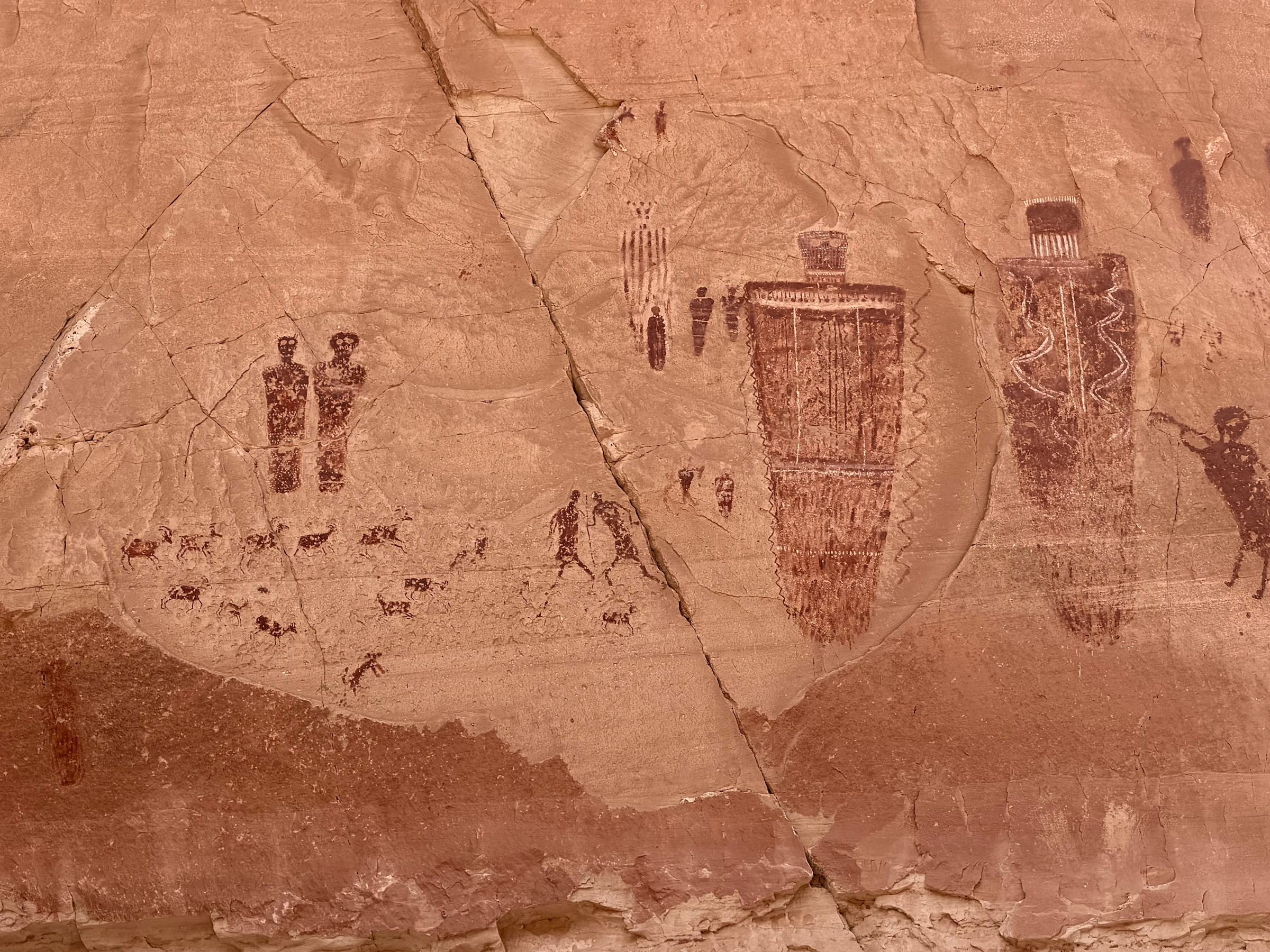
This section lies just to the right of the Holy Ghost. The artists seem to have placed many forms of different sizes wherever they liked across the gallery wall. Others they arranged into composed scenes.

This scene is full of motion. The bighorn sheep seem to be on the move and so does the dog with the curled tail. The two human-like figures on the right are masterfully drawn. Their arms and legs are clearly shaped and seem caught in mid-stride. To the left of this pair two smaller hard-to-see figures appear to be running. All of the forms in this scene have been pecked at while those in the upper right were left alone. The whole group was singled out for reasons we can only guess at.
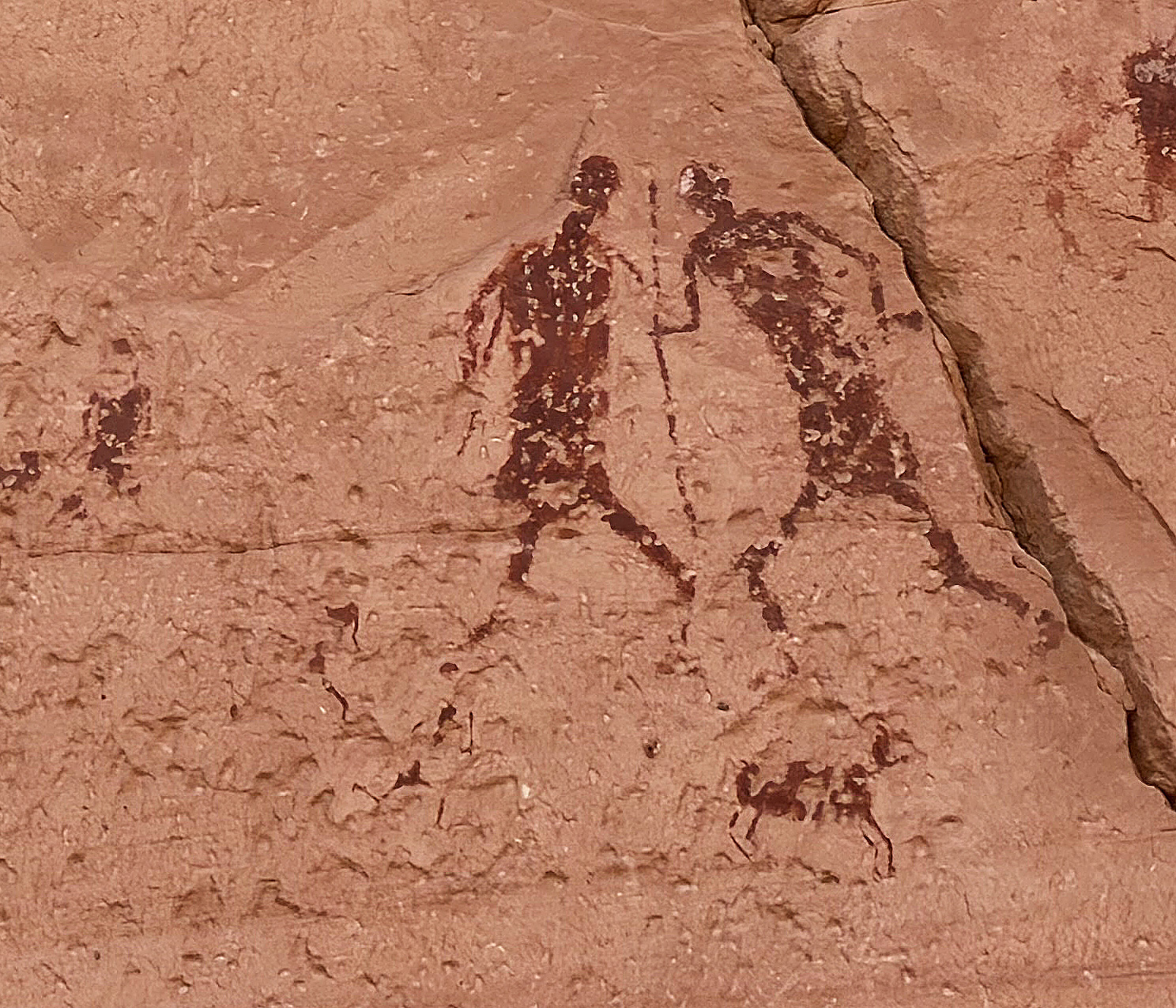
A closer view of the scene above. The two small running figures to the left of the pair are mostly pecked away but can still be made out.
Move your cursor over the photo (or tap it on a phone) to see an enhanced version.
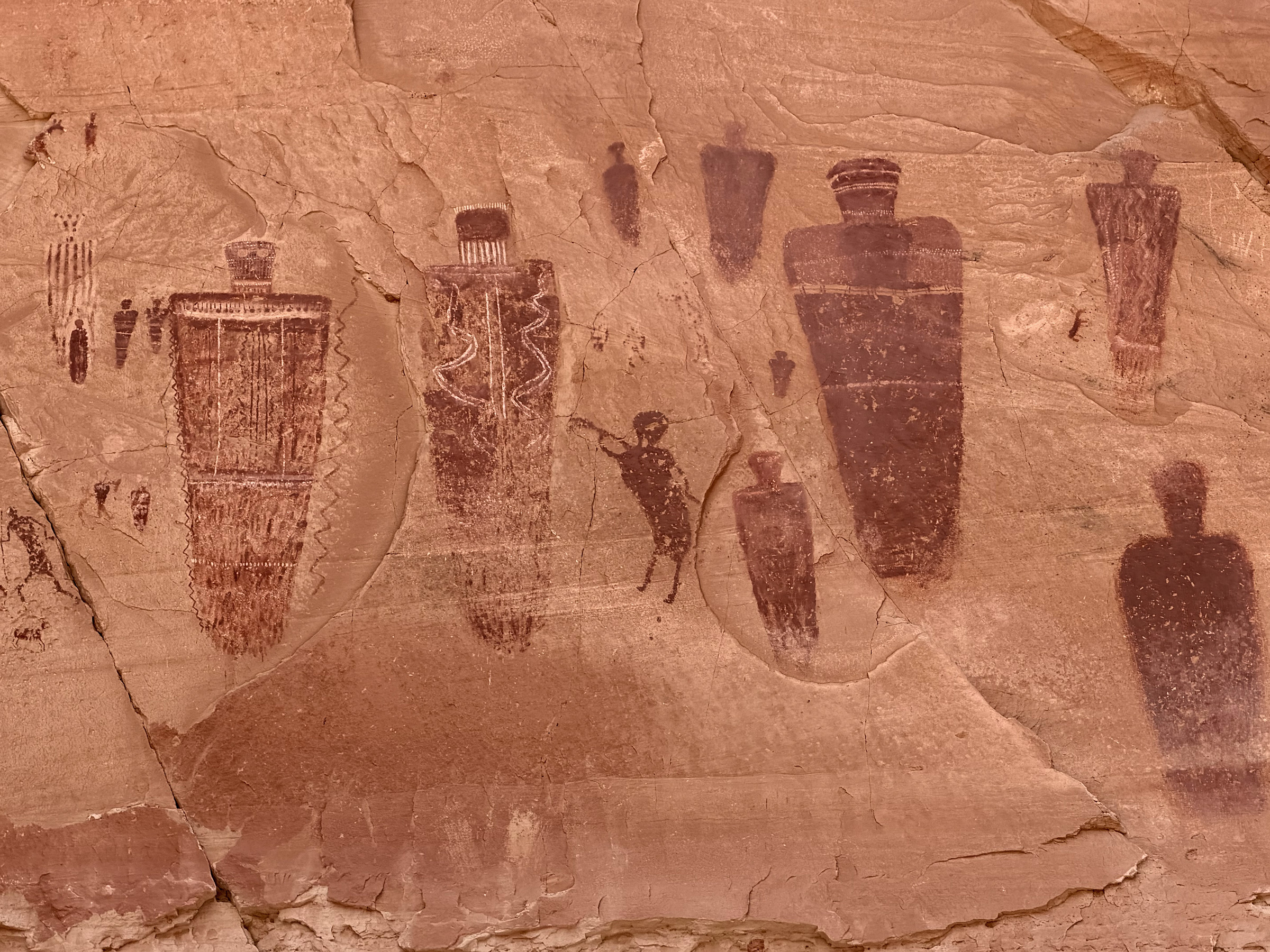
The two tall figures on the left are richly embellished. The others on the right may once have been as nicely decorated, but if so the detail has eroded away.
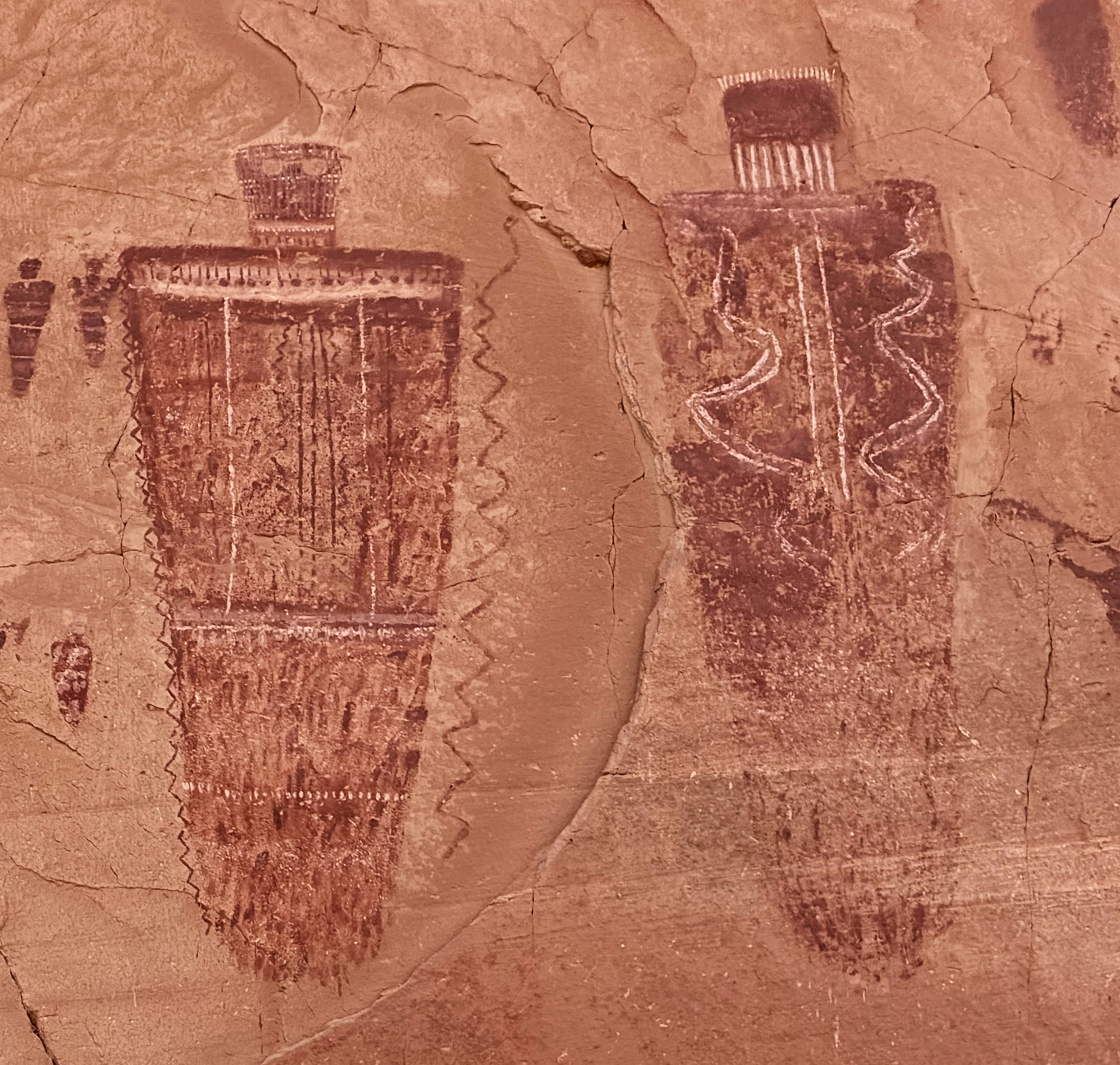
The creative use of white pigment makes these two figures stand out. In the figure on the left the artist seems to have applied white pigment first and then painted over it.
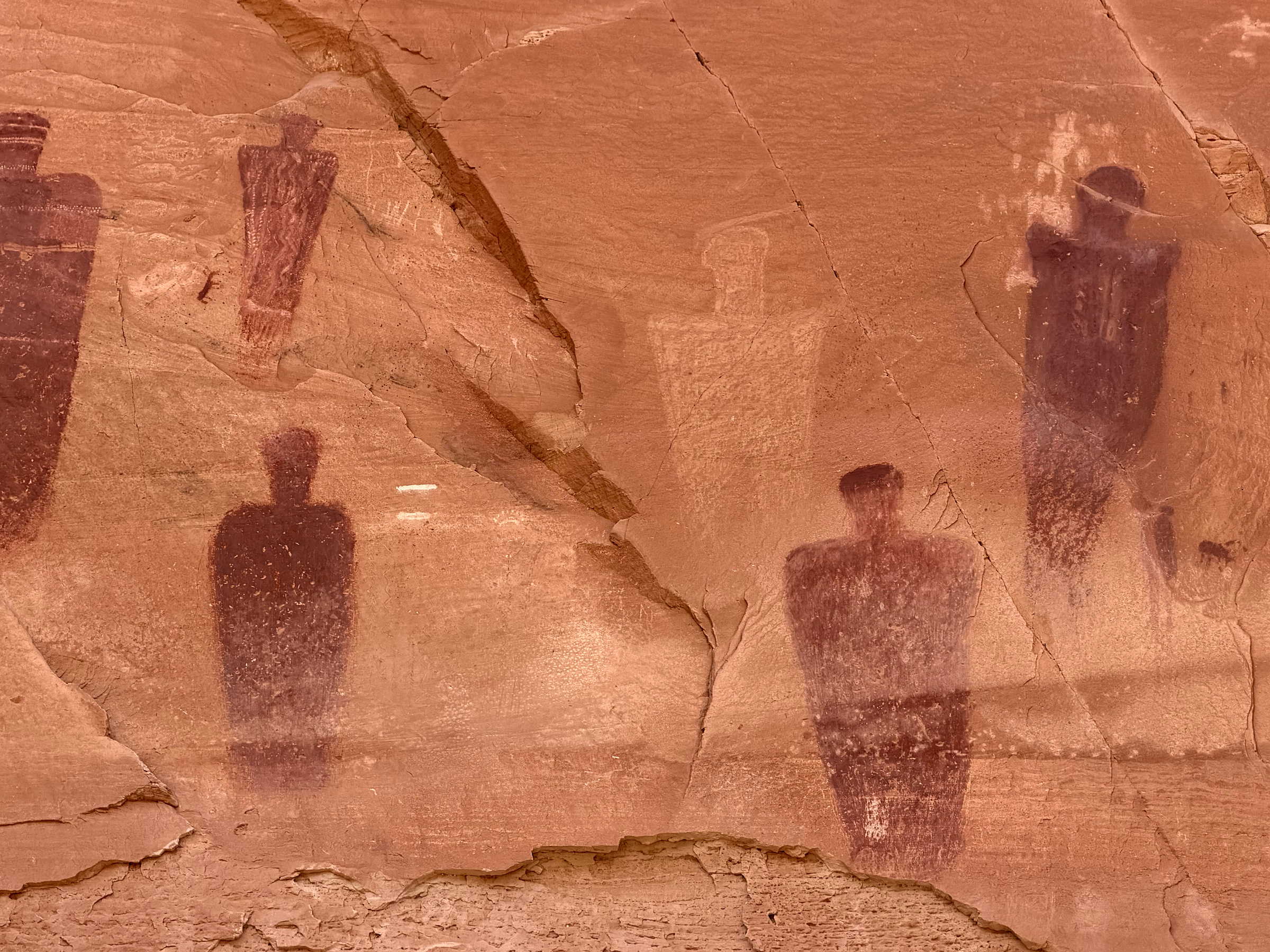
The fading of the paint is obvious here. It is likely all of these forms were embellished at one time.
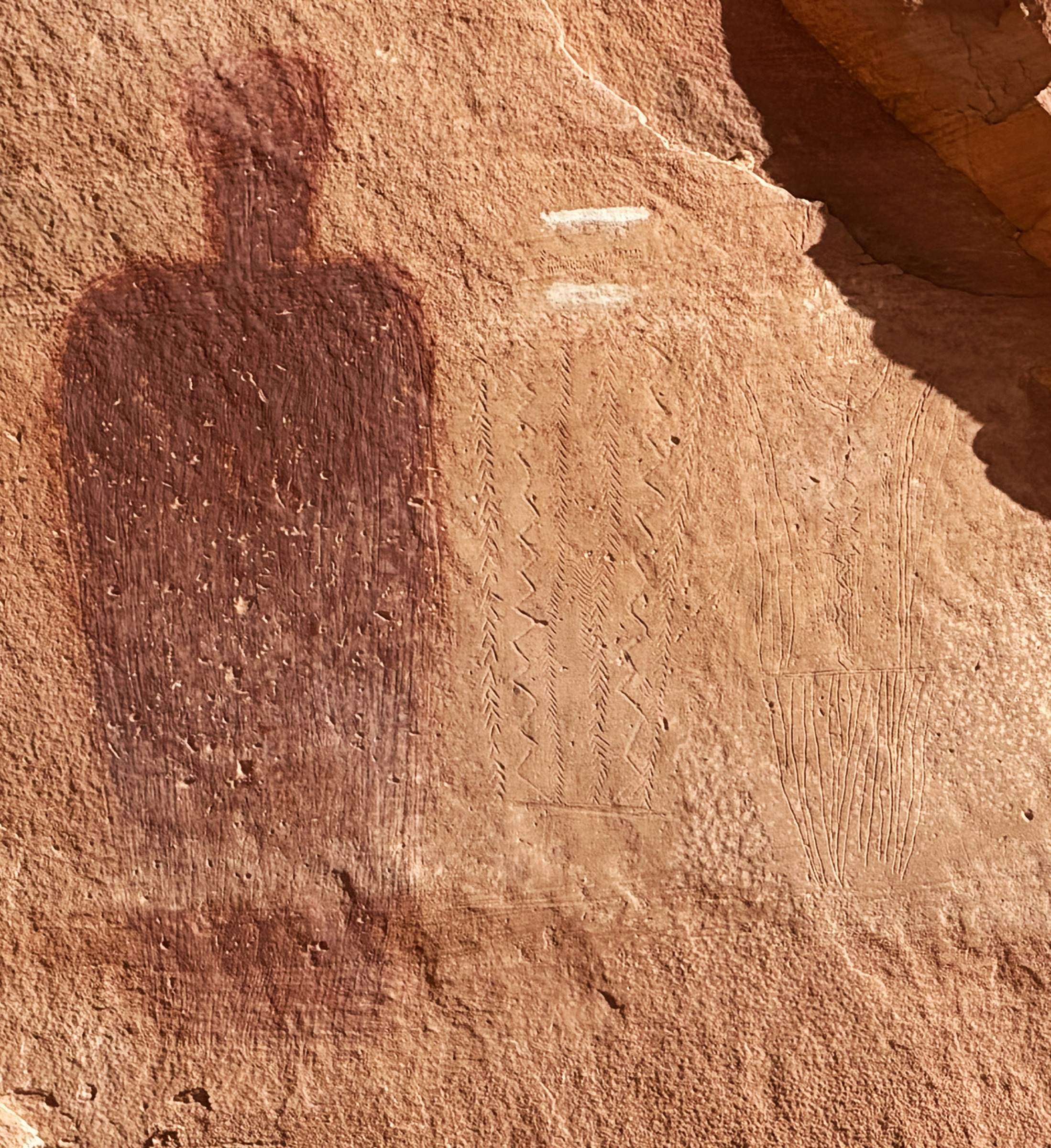
Beside this large dark figure are two forms that now show only fine scratched lines. One is filled with zigzags and chevrons and the other ends in long fringe-like strokes.
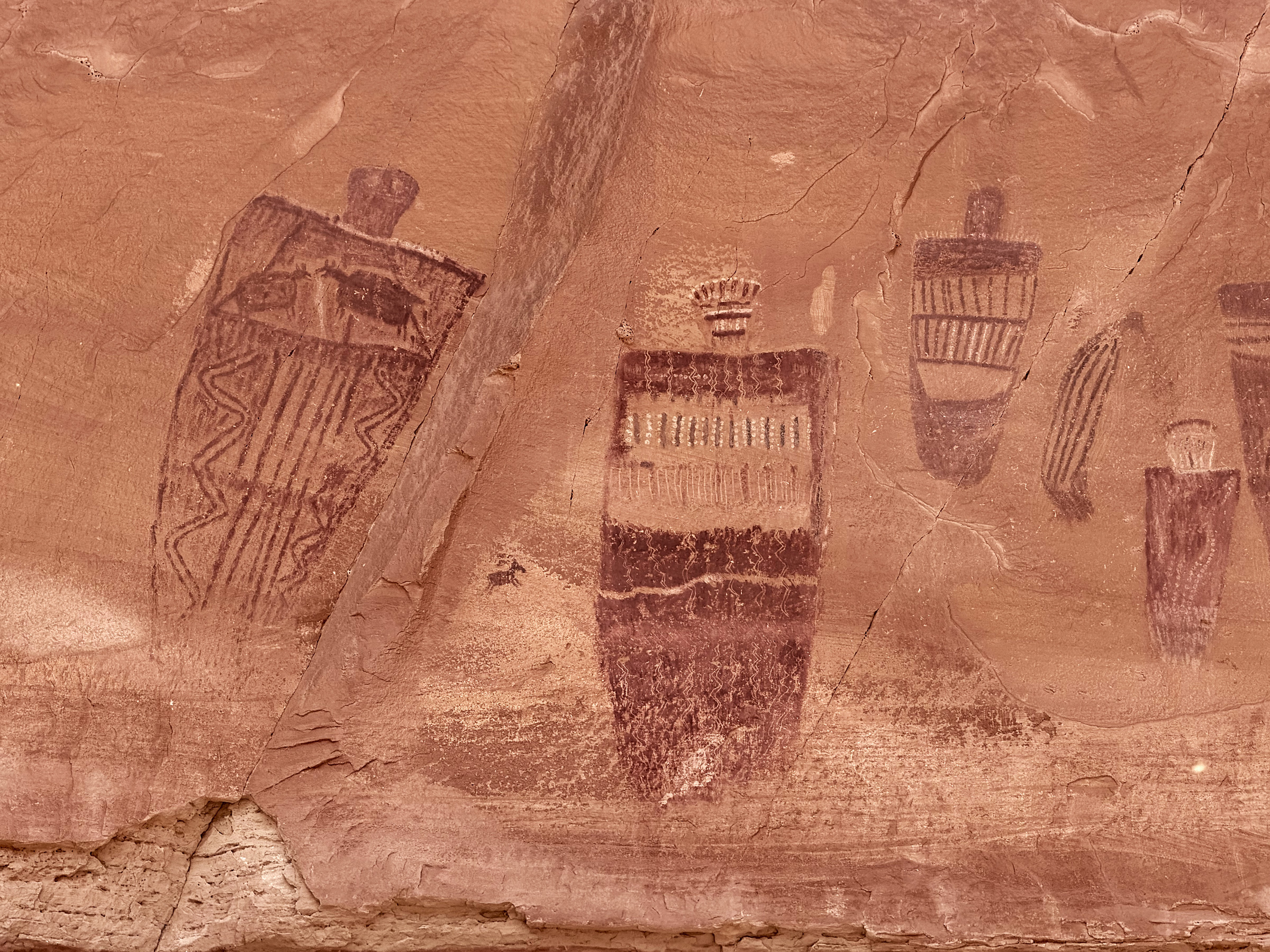
The figure on the left leans as if to follow the bulge in the cliff wall. Two animal forms are painted on its chest. The colorful central figure wears a crown-like headdress and its body is banded with a row of white dashes and covered with fine wavy lines. The artist seems to have used three or more colors of pigment.
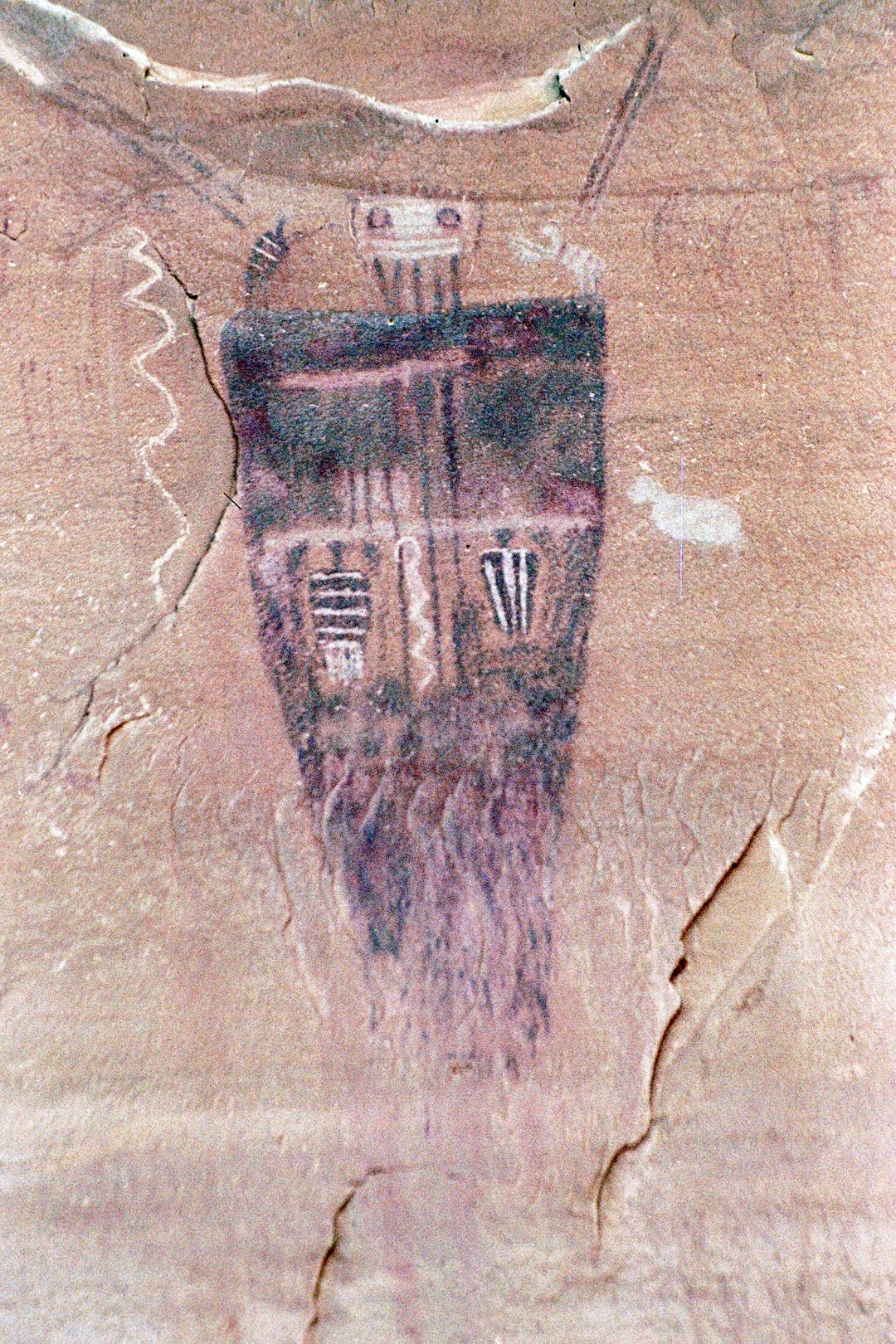
Barrier Canyon Style figures often have unpainted eyes but both figures here have painted ones. On the body of the figure on the right are two small human-like figures, one with horizontal stripes and the other with vertical stripes. Spirit helpers perch on its shoulders, one dark and one white. The line of dots between it and the banded figure on the left appears to be a procession of tiny sheep.
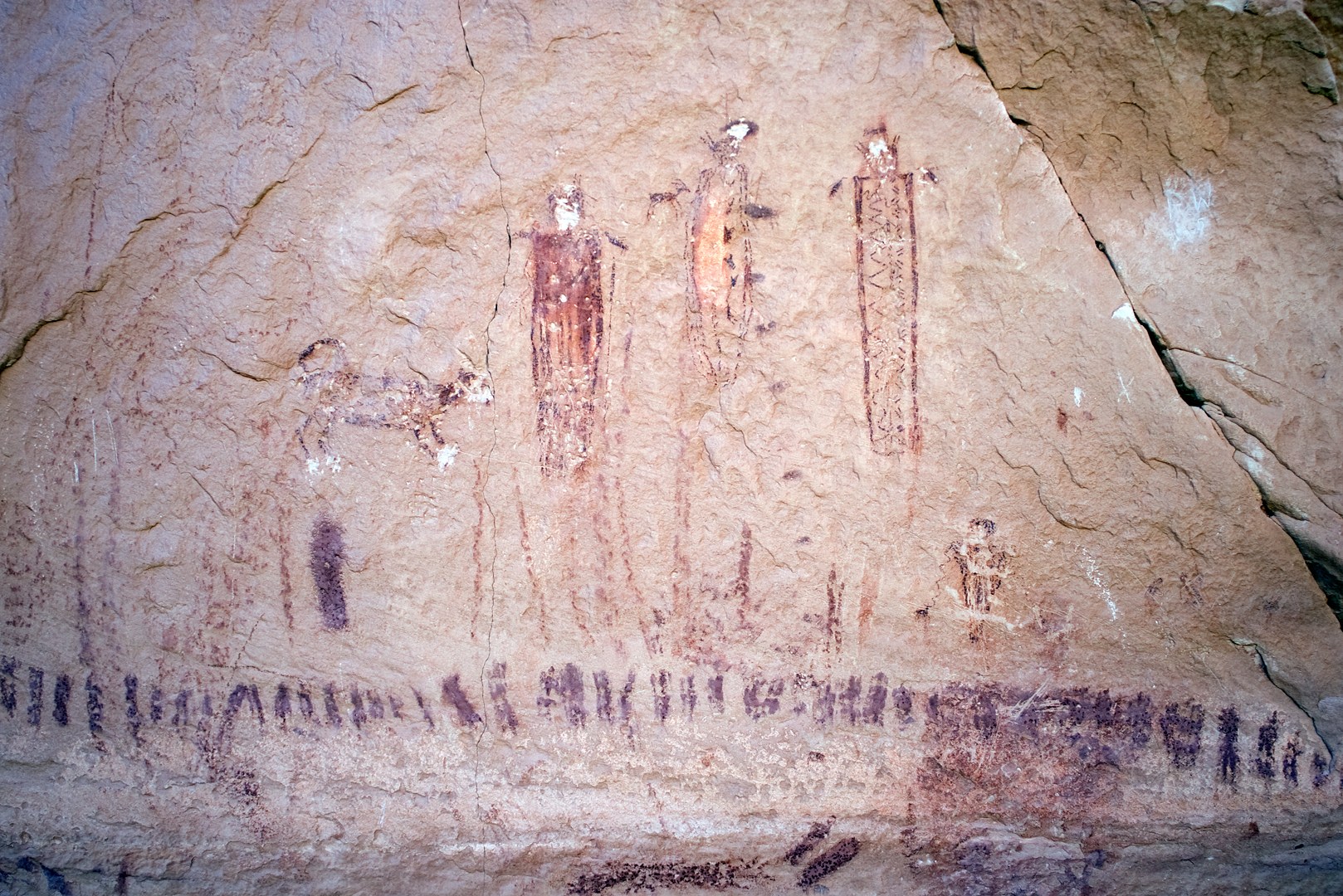
This photo and the next show panels to the left of the Holy Ghost scene. Long ago someone pecked away the faces and feet of the dog and the human-like figures, perhaps to take away their power. Mud may have served the same purpose on another panel.

To the left of the panel above stand these life-size figures. The white lines on the faces are unique. Why the artist painted them is an enigma. A pecked fringe runs along the bottom of the middle figure’s torso.
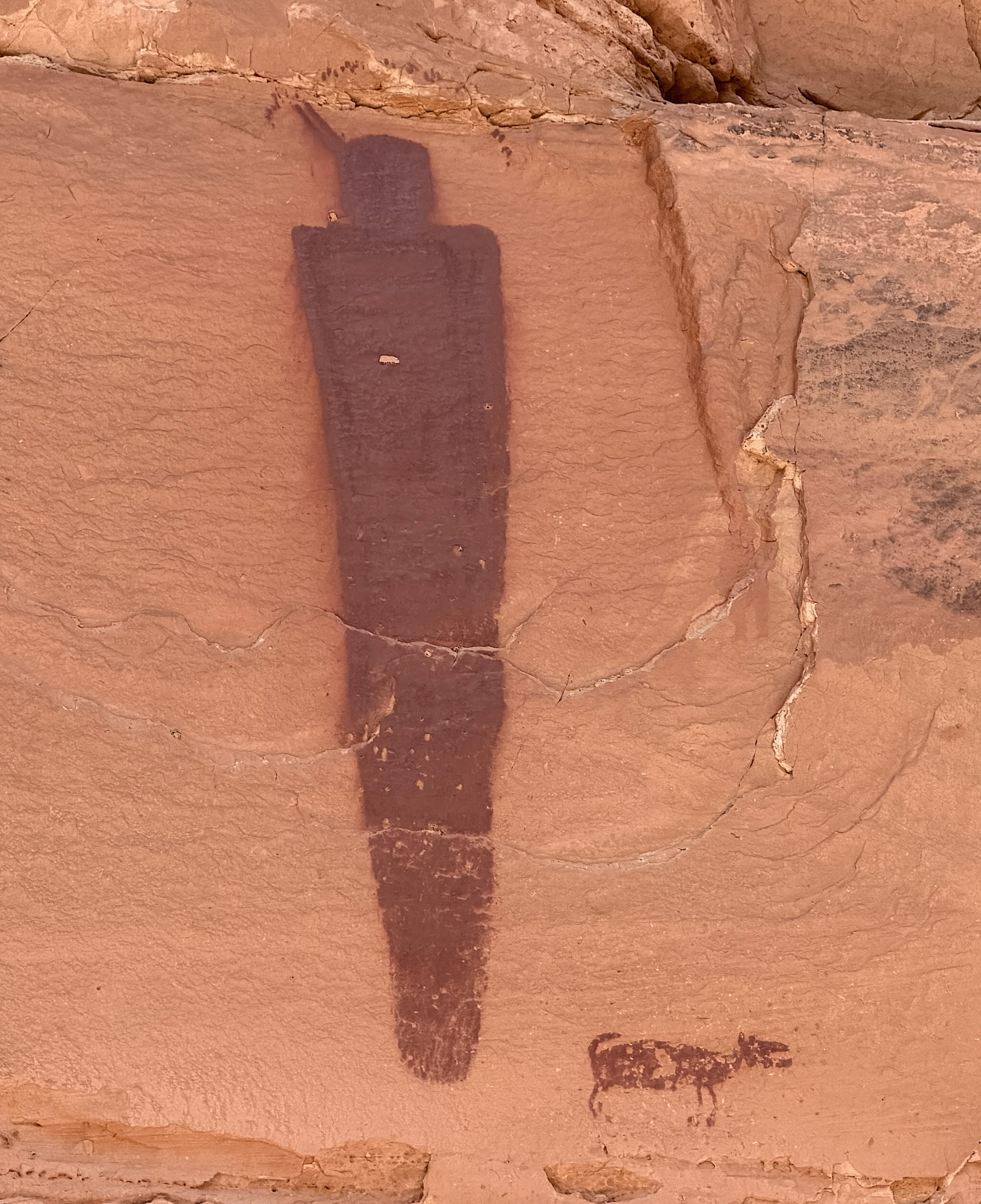
This tall figure stands at the far right end of the Great Gallery panel as if guarding it. The dog faces down canyon and seems to be barking.